

You may be considering nursing because you want to help people, build a meaningful future, or become part of the healthcare field.
Those are important reasons. But before you begin, you should understand what nursing school will ask of you.
Nursing is not only about learning medical facts or memorizing procedures. It requires you to analyze information, communicate clearly, establish priorities, accept feedback, and make responsible decisions in changing patient-care situations.
The right nursing program should help you develop those abilities step by step.
At Compu-Med Vocational Careers (CMVC), the Associate of Science in Nursing Program combines classroom instruction, laboratory work, simulation, and supervised clinical experiences. The goal is to help students connect what they learn with how nursing care is approached in practice.
Nursing Is More Than Wanting to Help People
Compassion matters in nursing, but compassion alone is not enough. Nurses must recognize important information, understand what it may mean, determine which concern requires attention, and communicate their observations to the healthcare team.
That is where critical thinking, clinical reasoning, and clinical judgment become essential: Critical thinking helps you examine information and compare possible responses. Clinical reasoning is how you apply your nursing knowledge to a specific patient situation. Clinical judgment is the decision or action that results from that process.
Imagine that two patients report the same symptom. Their medical history, medications, vital signs, and risk factors may be completely different. A nurse must identify what matters most in each situation rather than respond automatically.
The National Council of State Boards of Nursing includes clinical judgment in the 2026 NCLEX-RN Test Plan. Students preparing for nursing practice are expected to do more than remember information. They must learn how to use it safely.
CMVC’s nursing curriculum incorporates the nursing process, patient safety, communication, documentation, ethics, cultural considerations, and critical thinking.
As a student, you will be expected to participate actively, explain your reasoning, receive correction, and improve through practice.
You do not need to begin nursing school knowing everything. You do need to be willing to learn how to think like a nursing professional.
You Build Confidence Through Practice
Many future students worry that they will not feel confident enough to care for patients.
Confidence does not appear before training. It develops through preparation, repetition, feedback, and supervised experience.
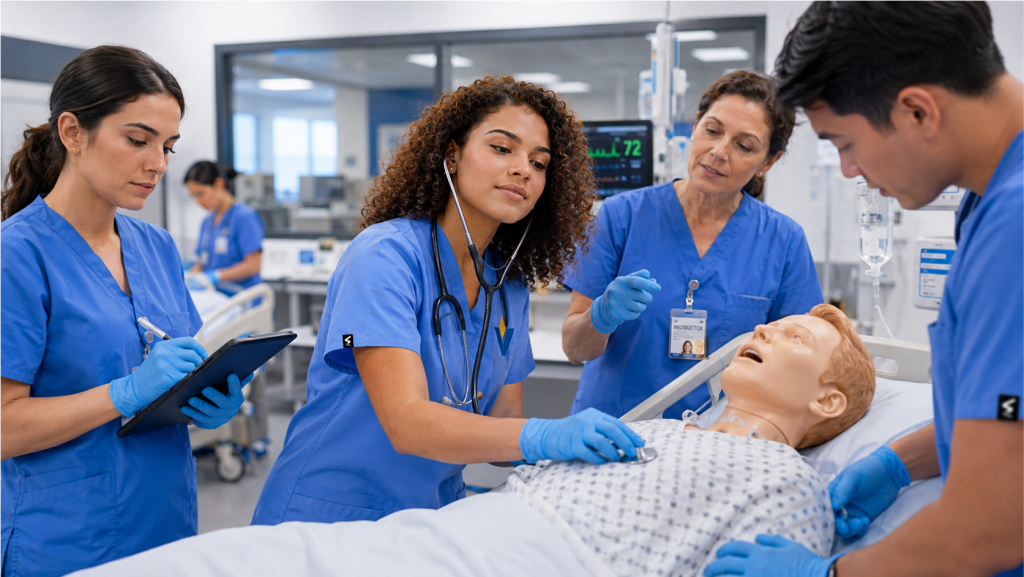
Nursing laboratories and simulations give students a structured environment in which to practice skills and work through patient-care scenarios.
You may practice how to:
Organize and interpret patient information.
Perform assessments.
Follow safety and infection-control procedures.
Communicate with patients and care teams.
Document observations.
Recognize which concern should receive priority.
Simulation also gives you the opportunity to make adjustments, review your performance, and learn from feedback before facing more complex situations.
CMVC’s Associate of Science in Nursing Program includes hands-on classroom instruction, clinical laboratory simulation, nursing labs, and clinical practice opportunities.
The curriculum includes areas such as Fundamentals of Nursing, Medical-Surgical Nursing, Maternal and Pediatric Nursing, Psychiatric Nursing, Nursing Leadership, Preceptorship, and Capstone experiences.
CMVC’s hands-on laboratory experiences are designed to support the development of cognitive, psychomotor, and affective skills, while strengthening critical thinking, clinical reasoning, and clinical judgment.
Clinical experiences then help students connect foundational knowledge with supervised healthcare settings.
These are educational experiences, not independent professional practice. Students must follow program requirements, clinical-site policies, and the limits associated with their level of preparation.
Before choosing a nursing program, ask yourself:
Am I ready to practice consistently? Can I receive feedback without giving up? Am I prepared to meet attendance, clinical, health, screening, and scheduling requirements?
Understanding those expectations now can help you make a more informed decision.
The Opportunity Is Real—and So Is the Responsibility
Healthcare continues to create opportunities for trained professionals.
The U.S. Bureau of Labor Statistics projects approximately 1.9 million openings per year across healthcare occupations from 2024 to 2034. This includes both employment growth and the need to replace workers who permanently leave their occupations.
For Registered Nurses specifically, the BLS projects:
5% employment growth from 2024 to 2034.
Approximately 166,100 additional RN positions during the decade.
Approximately 189,100 RN openings each year, including replacement needs.
Factors such as an aging population, chronic health conditions, retirements, and the need for care across different healthcare settings continue to influence demand.
These projections do not guarantee employment, salary, licensure, or career advancement.
Your results will depend on factors such as completing your education, passing the required examination, meeting state licensing requirements, your location, experience, and employer expectations.
What these projections do show is that healthcare needs nurses who can think critically, communicate effectively, collaborate with others, adapt to change, and protect patient safety.
Successfully completing CMVC’s program can lead to an Associate of Science in Nursing and eligibility to take the National Council Licensure Examination for Registered Nurses (NCLEX-RN).
Graduation alone does not provide an RN license. Candidates must pass the examination and satisfy the applicable state requirements.
Before you begin, consider both sides of the decision.
Nursing may give you the opportunity to serve others and participate in an essential field. It will also require commitment, discipline, accountability, and continuous learning.
Your first step is not having all the answers. Your first step is choosing a program that can help you develop the knowledge, judgment, skills, and confidence the journey requires.
Are you ready to explore your next step?
Learn more about the Associate of Science in Nursing Program at CMVC, review the admission requirements, and speak with a CMVC Admissions Advisor about what to expect.
Start your path to progress with CMVC.
Sources
U.S. Bureau of Labor Statistics: Healthcare Occupations
U.S. Bureau of Labor Statistics: Registered Nurses
National Council of State Boards of Nursing: 2026 NCLEX-RN Test Plan
Health Resources and Services Administration: Health Workforce Projections