

In an emergency, every second matters. Whether responding to a medical emergency, a serious accident, or a sudden health crisis, emergency medical services (EMS) teams must reach patients as quickly and safely as possible. In busy urban areas like Miami, heavy traffic, road closures, and high call volumes can make timely emergency response especially challenging.
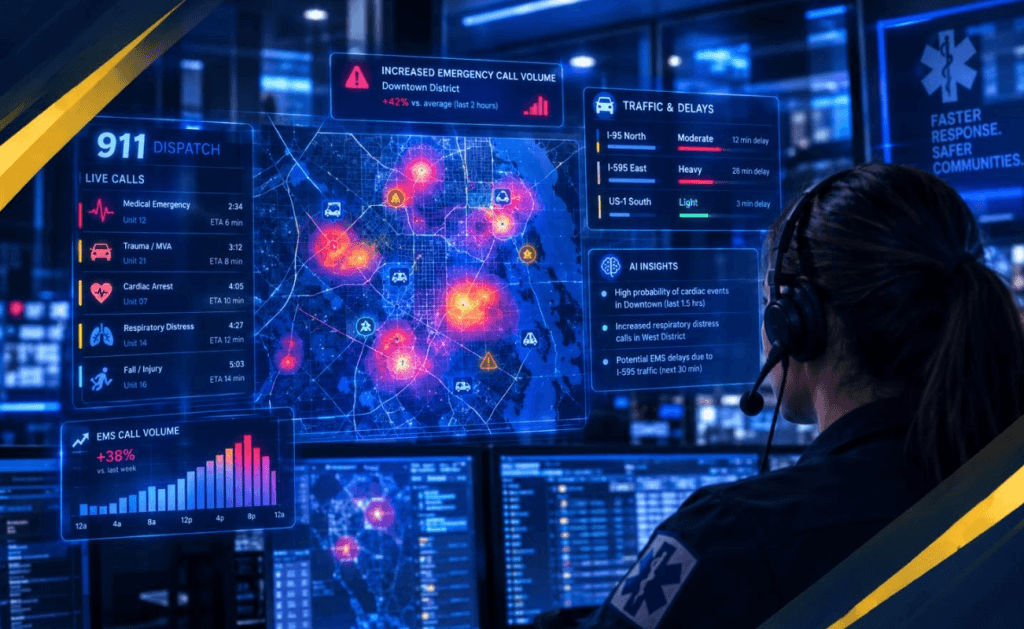
Artificial intelligence (AI) and machine learning are transforming how emergency dispatch centers manage these challenges. Through AI-powered dispatch systems and predictive routing technology, emergency services can analyze real-time information, anticipate demand, and identify more efficient routes for ambulances. These innovations are helping EMS agencies explore new ways to improve response times, allocate resources, and support patient care.
For individuals interested in becoming Emergency Medical Technicians (EMTs), understanding these technological developments provides valuable insight into the future of emergency medicine and the skills needed to work in an increasingly data-driven healthcare environment.
What Is AI-Powered Emergency Dispatch?
AI-powered emergency dispatch uses artificial intelligence to help dispatchers process emergency calls, evaluate available information, and coordinate emergency response resources. Traditional dispatch systems rely heavily on established protocols, dispatcher experience, and computer-aided dispatch software. AI adds analytical capabilities that can help identify patterns and support faster decision-making.
Machine learning, a branch of artificial intelligence, allows computer systems to identify patterns in historical and current data. In emergency medical services, these systems may analyze information such as previous call volumes, incident locations, traffic conditions, weather patterns, and ambulance availability.
Based on the information available, AI-powered tools can help dispatch centers:
- Identify areas experiencing increased emergency call volumes.
- Support the prioritization of calls according to established medical dispatch protocols.
- Recommend appropriate response resources based on incident details and availability.
- Identify potential delays caused by traffic or road conditions.
- Help dispatchers recognize patterns that may affect emergency response operations.
These systems are designed to assist trained professionals rather than replace them. Emergency dispatchers remain essential for evaluating information, communicating with callers, applying established protocols, and coordinating the appropriate response.
How Predictive Routing Uses Machine Learning to Improve Response Times
Predictive routing is one of the most promising applications of machine learning in emergency medical services. Instead of relying exclusively on a route’s current estimated travel time, predictive routing can use historical data and real-time conditions to estimate how travel conditions may change.
This is particularly valuable in metropolitan areas where traffic patterns can shift rapidly throughout the day.
1. Analyzing Real-Time Traffic Conditions
Traffic congestion is a major challenge for ambulance crews working in busy cities. Accidents, construction, special events, and rush-hour traffic can delay travel even when an emergency vehicle is responding with lights and sirens.
AI-powered routing tools can analyze available traffic information and identify routes that may offer a more efficient journey. Depending on the system, this information may include current vehicle speeds, reported road closures, congestion levels, and estimated travel times.
For example, an ambulance responding to an emergency in downtown Miami may encounter unexpected congestion along a major roadway. A routing system could recommend an alternative route based on current conditions and available road information.
The dispatcher and ambulance crew can then consider the recommendation while following traffic laws, agency procedures, and emergency vehicle safety requirements.
2. Predicting Future Traffic Patterns
Machine learning can analyze historical traffic data to estimate how road conditions may change at different times of day.
If a particular corridor regularly experiences heavy congestion during the evening commute, a predictive routing system may account for that pattern when estimating travel times. Weather conditions, large public events, and other available information may further improve these estimates.
Predictive traffic analysis can help emergency services prepare for recurring delays rather than simply reacting after congestion develops.
However, predictions are estimates, not guarantees. Unexpected incidents and changing road conditions can still affect an ambulance’s arrival time.
3. Identifying the Most Appropriate Available Ambulance
Predictive routing can also support decisions about which ambulance should respond to an incident.
The closest ambulance is not always the most appropriate resource. Dispatch centers may need to consider the unit’s current location, availability, capabilities, and the nature of the emergency.
AI-assisted dispatch systems can analyze these factors and recommend a suitable unit based on agency rules and operational requirements. The system may also consider predicted travel times rather than distance alone.
This can help agencies coordinate resources more effectively while maintaining coverage for other emergencies.
4. Anticipating Where Emergency Calls May Occur
Predictive analytics can help EMS agencies identify locations that historically experience higher emergency call volumes at particular times.
For example, historical data may reveal recurring demand near busy commercial districts, major roadways, or areas hosting large public gatherings. Agencies can use these insights to evaluate ambulance staging locations and staffing plans.
In Miami, this type of planning may be especially relevant during major events, periods of heavy tourism, and times when traffic conditions create transportation challenges.
Predicting demand does not mean that individual emergencies can be known in advance. Instead, it allows agencies to make informed decisions about where resources may be needed, while accounting for uncertainty and avoiding unfair assumptions about communities.
How AI-Powered Dispatch Can Affect EMS Response Times
Emergency response time includes several stages, from receiving an emergency call to dispatching an ambulance, traveling to the scene, and reaching the patient. AI may influence different parts of this process, but the impact depends on how the technology is implemented.
Faster Information Processing
Some AI systems can assist with organizing information from emergency calls, identifying relevant details, and supporting dispatchers as they determine the appropriate response.
When these tools are reliable and integrated into existing workflows, they may help reduce certain administrative delays. However, they must be carefully evaluated to ensure that important information is not overlooked and that emergency calls are prioritized appropriately.
More Efficient Ambulance Deployment
Predictive analytics can help dispatch centers understand where ambulances are located, which units are available, and where demand may increase.
This information can support more strategic resource allocation. For example, an agency may decide to reposition an available ambulance closer to an area expected to experience increased demand, provided that doing so does not leave other communities without adequate coverage.
Improved Route Planning
By accounting for traffic conditions and predicted travel times, routing systems may help crews avoid preventable delays.
However, the actual improvement in response times depends on factors such as road conditions, ambulance availability, dispatch procedures, geographic barriers, and the reliability of the underlying data. Agencies should measure real-world performance rather than assume that implementing AI automatically produces faster responses.
Better Operational Planning
Emergency services can use historical data to evaluate patterns in call volume, response delays, and resource utilization.
These insights may help administrators identify recurring bottlenecks, adjust staffing, improve deployment strategies, and determine where additional resources could have the greatest impact.
Ultimately, AI is most useful when it supports a coordinated emergency response system rather than functioning as a standalone solution.
The Challenges of Using AI in Emergency Medical Services
Although AI-powered dispatch and predictive routing offer potential benefits, emergency medical services must address several important challenges before relying on these technologies.
Data Accuracy and Reliability
Machine learning systems depend on the quality of the data used to train and operate them. Incomplete incident records, outdated road information, or inaccurate ambulance status updates can produce unreliable recommendations.
EMS agencies must maintain accurate records, evaluate system performance, and establish procedures for correcting errors.
Human Oversight and Clinical Judgment
Emergency calls can involve complex medical situations that do not fit neatly into predictable patterns. An algorithm may identify a trend, but it cannot automatically account for every detail of a patient’s condition or the circumstances at an emergency scene.
Dispatchers and EMS professionals must retain appropriate decision-making authority. AI recommendations should support established medical dispatch protocols and be reviewed when circumstances require professional judgment.
Privacy and Data Protection
Emergency dispatch systems may process sensitive information about patients, locations, and medical incidents.
Organizations using AI must protect this information through appropriate access controls, data security practices, and compliance with applicable privacy requirements. They should also evaluate how information is stored, shared, and used to train or improve algorithms.
Equity and Potential Bias
Historical emergency data may reflect differences in access to healthcare, reporting practices, and the availability of emergency services across communities.
If a predictive system learns from biased or incomplete data, its recommendations may reinforce existing inequalities. Agencies should evaluate whether their systems perform consistently across different populations and geographic areas.
Cost, Training, and Integration
Implementing AI technology may require new software, infrastructure, staff training, and integration with existing dispatch systems.
Agencies must determine whether the technology provides measurable benefits and whether dispatchers and field personnel can use it effectively. Technology should improve the emergency response process without creating unnecessary complexity or introducing new safety risks.
How EMTs Will Work With AI and Predictive Routing
AI-powered dispatch does not eliminate the need for skilled emergency medical personnel. Instead, it changes some of the tools and information that EMTs may encounter during their work.
As these technologies become more widely adopted, EMTs may receive updated navigation information, more detailed dispatch notes, or recommendations informed by real-time traffic and operational data.
Future EMTs should be prepared to combine these digital tools with essential clinical and communication skills.
Important competencies include:
- Patient assessment: Recognizing signs and symptoms, identifying urgent medical needs, and following established care protocols.
- Communication: Sharing accurate information with dispatchers, paramedics, receiving facilities, and other emergency personnel.
- Situational awareness: Evaluating hazards, traffic conditions, and changes at an emergency scene.
- Technology literacy: Understanding how to use digital dispatch information and navigation tools without relying on them blindly.
- Adaptability: Adjusting to changing conditions while maintaining patient safety and professional standards.
Even when an AI system recommends a route or identifies a nearby ambulance, trained professionals must ensure that the response remains appropriate to the situation.
For students pursuing EMT training in Miami, developing a strong foundation in emergency care can help prepare them to work alongside evolving technologies throughout their careers.
The Role of EMT Education in a Technology-Driven Future
The future of emergency medical services will depend on both technological innovation and the professionals who deliver patient care.
AI-powered dispatch and predictive routing may help emergency services use information more effectively, but these systems cannot replace the need for EMTs who understand patient assessment, emergency procedures, teamwork, and safe decision-making.
Quality EMT education helps students develop the practical knowledge and professional skills required to respond to medical emergencies. It also provides a foundation for understanding how communication systems, digital tools, and changing industry practices fit into the broader EMS environment.
CompuMed Vocational Careers (CMVC) serves individuals exploring healthcare education in Miami. Prospective students interested in emergency medical services can explore available training options and learn more about preparing for a healthcare career.
As technology continues to change emergency response, future EMTs who combine clinical competence with adaptability and responsible technology use will be better prepared to meet the profession’s evolving demands.
Supporting EMT Wellness in a Demanding Profession
Working in emergency medical services can involve long shifts, unpredictable schedules, physical demands, and stressful situations. Maintaining personal well-being is an important part of supporting a sustainable healthcare career.
EMTs can support their general health by prioritizing adequate sleep, balanced nutrition, hydration, appropriate physical activity, and access to qualified healthcare professionals. These habits can help support overall well-being, although they cannot eliminate the effects of occupational stress or replace appropriate medical care.
CMVC Clinic & Labs in Miami offers personalized wellness services, including IV therapy, vitamin blends, injectables, and weight loss treatments. Individuals interested in these services should consult a qualified healthcare professional to determine whether a treatment is suitable for their health needs. Wellness treatments should not be considered substitutes for adequate rest, evidence-based medical care, or workplace safety measures.
CMVC Clinic & Labs also provides school and work medical entry examinations, along with services such as physical exams, drug testing, titers, and selected vaccines. Prospective healthcare students can contact the clinic to learn about available services and requirements for their educational or employment needs.
What the Future Holds for AI in Emergency Dispatch
AI-powered dispatch and predictive routing are changing how emergency services evaluate information, plan routes, and coordinate ambulances. By combining historical data with real-time conditions, these systems can help agencies anticipate demand, identify potential travel delays, and make more informed operational decisions.
However, technology alone cannot guarantee shorter response times or better patient outcomes. Reliable data, appropriate human oversight, responsible implementation, and well-trained emergency medical personnel remain essential.
For aspiring EMTs in Miami, learning about these innovations offers a glimpse into the future of emergency medical services. As dispatch technology continues to evolve, the ability to combine clinical knowledge, communication skills, and technological awareness will remain valuable.
If you are considering a future in healthcare, explore your educational options with CMVC and take the first step toward learning more about the emergency medical services profession.
Ready to take the next step? Contact CMVC in Miami to explore healthcare education opportunities and learn more about the services available through CMVC Clinic & Labs. Building a future in healthcare begins with the right knowledge, preparation, and commitment to helping others.